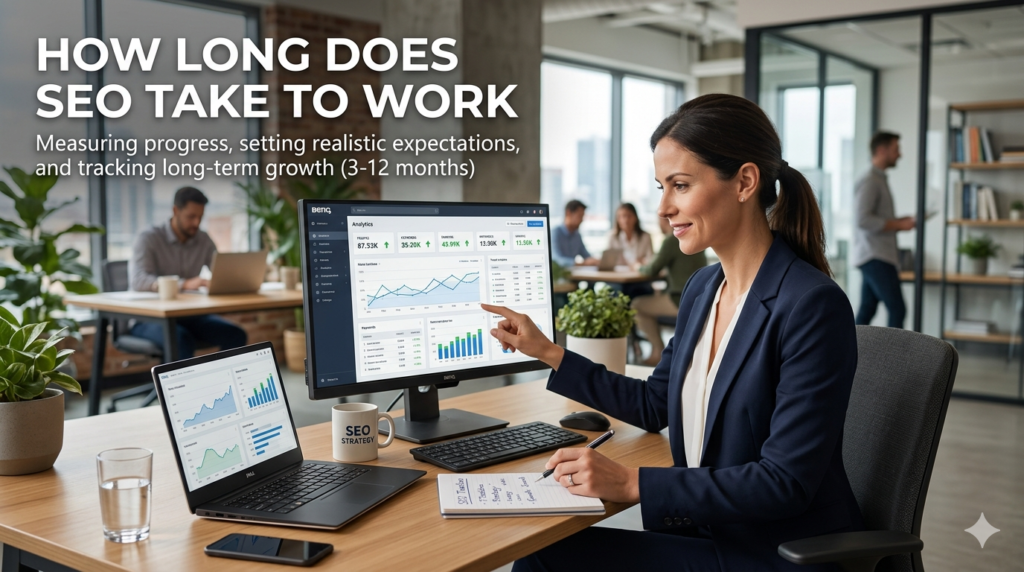
If you’re investing in digital marketing, you’ve probably asked yourself: how long does SEO take to work? Understanding the timeline for SEO results is crucial for setting realistic expectations and measuring the return on your investment. Unlike paid ads, SEO is a long-term strategy that builds sustainable traffic, but it requires patience and careful planning.
For businesses of all sizes, knowing when SEO starts to deliver results can help in budgeting, planning campaigns, and prioritizing efforts that truly impact growth. In this article, we’ll break down the factors affecting SEO timelines, provide actionable tips to accelerate results, and discuss whether SEO is still worth it in today’s competitive digital landscape.
Understanding SEO and Its Impact
SEO, or Search Engine Optimization, is the process of optimizing a website so it ranks higher on search engine results pages (SERPs). It involves a combination of technical improvements, content creation, user experience enhancements, and link-building strategies.
Key components of SEO include:
- On-page SEO: Optimizing titles, meta descriptions, headings, and content for relevant keywords.
- Technical SEO: Improving site speed, mobile-friendliness, structured data, and crawlability.
- Off-page SEO: Building high-quality backlinks and improving brand authority.
- Content strategy: Creating informative and engaging content that meets user intent.
The ultimate goal is to increase organic traffic, generate leads, and boost conversions. However, SEO is not instantaneous—results unfold over weeks or months, depending on several factors.
How Long Does SEO Take to Work?
There is no one-size-fits-all answer, but SEO generally follows a timeline that can be broken down into short-term, mid-term, and long-term results.
1. Short-Term (0–3 Months)
Activities: Technical fixes, keyword research, on-page optimization, content audits.
Expected Results: Initial improvements in crawlability and indexation; small boosts in rankings for low-competition keywords.
Example: A local bakery optimizing its website for “gluten-free cupcakes near me” may start seeing impressions within a few weeks.
2. Mid-Term (3–6 Months)
Activities: Consistent content creation, link-building campaigns, UX improvements.
Expected Results: Noticeable traffic growth, rankings for primary keywords start improving, and user engagement metrics begin to rise.
Example: A B2B SaaS company publishing weekly blog posts targeting niche keywords might see lead generation increase after four months.
3. Long-Term (6–12+ Months)
Activities: Scaling content strategy, acquiring authoritative backlinks, expanding to competitive keywords.
Expected Results: Significant organic traffic growth, higher search visibility, and measurable ROI.
Example: An e-commerce site targeting competitive product categories could reach top SERP positions after 9–12 months of consistent effort.
Key Insight: For most businesses, expecting results in under three months is unrealistic. SEO is a marathon, not a sprint.
Factors That Influence SEO Timelines
Several variables determine how quickly SEO delivers results:
- Competition: Highly competitive industries take longer to rank.
- Domain Authority: Established websites generally rank faster than new sites.
- Content Quality: High-value, well-structured content accelerates results.
- Technical Health: Sites with slow loading times or crawl issues may see delayed results.
- Consistency: Frequent, sustained efforts outperform sporadic SEO activity.
By understanding these factors, businesses can set realistic expectations and focus on strategies that truly move the needle.
Practical Tips to Accelerate SEO Results
While patience is required, you can take proactive steps to see faster outcomes:
- Focus on low-hanging keywords: Targeting less competitive, long-tail keywords can generate quicker wins.
- Optimize existing content: Refreshing older content can boost rankings without starting from scratch.
- Build authoritative backlinks: Partnerships, guest posts, and PR outreach enhance credibility.
- Leverage local SEO: For location-based businesses, optimizing Google Business Profiles accelerates visibility.
- Monitor and adapt: Use analytics tools to track performance and adjust strategies in real-time.
Pro Tip: Combining SEO with complementary channels like social media or email marketing can amplify results while organic traffic grows.
Common SEO Misconceptions
Many businesses make assumptions that delay success or cause frustration:
“SEO is instant.” Realistically, it takes months to see meaningful results.
“Once you rank, you’re set.” SEO requires ongoing effort—search algorithms and competitors change constantly.
“More content is always better.” Quality and relevance outweigh sheer volume.
“Paid ads can replace SEO.” Ads provide immediate visibility, but SEO delivers long-term organic growth.
By avoiding these pitfalls, businesses can maximize the effectiveness of their SEO strategy.
Is SEO Still Worth It?
Absolutely. Even in 2026, SEO remains a vital channel for organic growth:
- Sustainable traffic: Unlike paid ads, organic traffic continues long after initial efforts.
- Cost-effective: Although initial investment may be high, ROI over time is substantial.
- Trust and credibility: Users often trust organic search results more than ads.
- Competitive advantage: Businesses that maintain strong SEO outperform those that ignore it.
For beginners and seasoned marketers alike, SEO is not just worth it—it’s essential.
So, how long does SEO take to work? The answer depends on your website’s current state, industry competition, and the strategies you implement. Typically, businesses start seeing small results within 3 months, moderate results within 6 months, and significant impact after 12 months of consistent effort.
Patience, quality content, technical optimization, and strategic link-building are the keys to successful SEO. While it takes time, the payoff—sustainable traffic, leads, and authority—is well worth the investment.
For businesses asking, “Is SEO still worth it?”, the answer remains a resounding yes. Long-term growth in the digital landscape is closely tied to SEO success, making it a cornerstone of any comprehensive marketing strategy.